


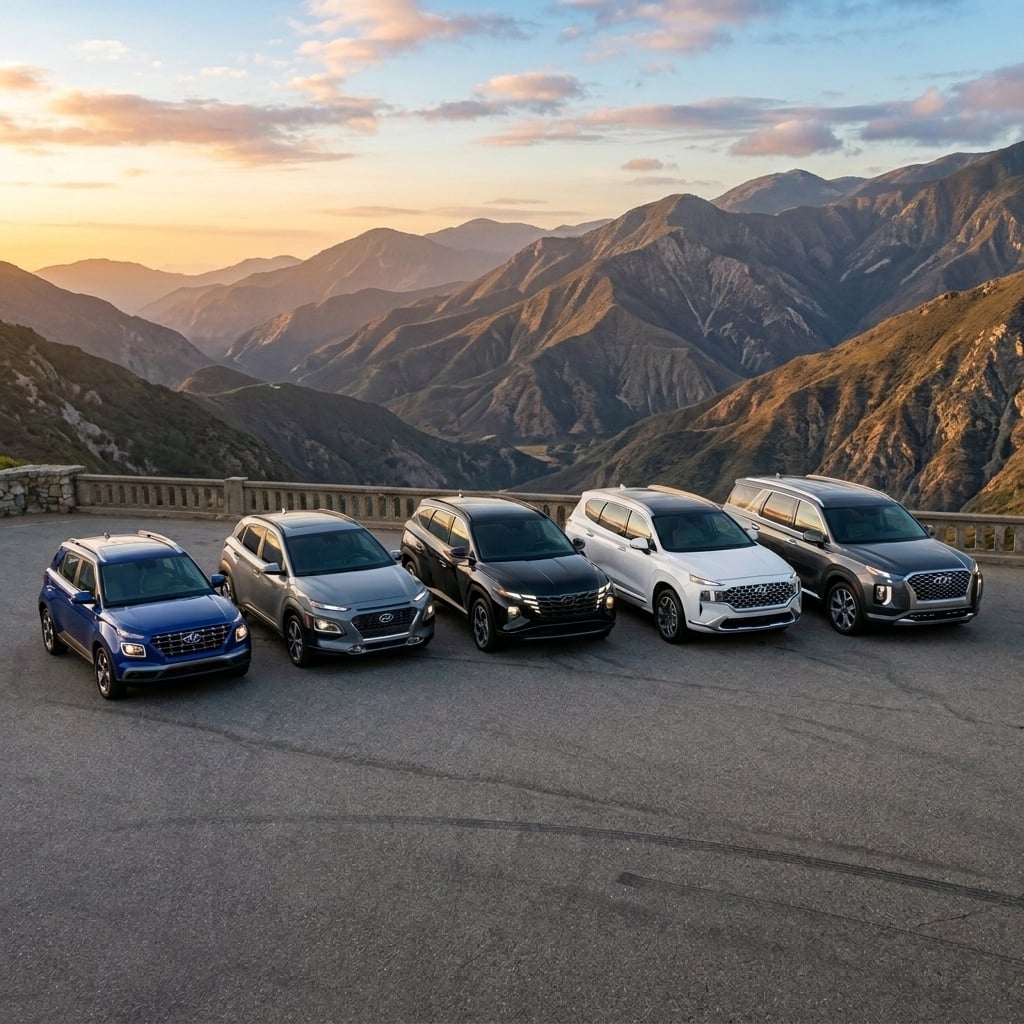
How Do Hyundai SUV Sizes, Features, and Powertrains Compare Across the Lineup?
The Hyundai utility lineup spans multiple dimensional classes, giving vehicle shoppers options ranging from agile subcompact crossovers to spacious multi-row family haulers. Entry-level models like the Venue and Kona prioritize nimble handling and easy parking. Moving up to the Tucson provides a balanced compact footprint with comfortable five-passenger seating and enhanced cargo space.
For expanding families, the midsize Santa Fe offers dynamic exterior styling and flexible cabin configurations. The flagship Palisade elevates capacity further, delivering three full rows of seating and premium cabin appointments. Drivers interested in alternative fuels can explore zero-emission options like the IONIQ 5 or the all-electric three-row IONIQ 9, which offers an extended driving range starting at $58,955 MSRP.
Engine configurations across these models range from efficient four-cylinder engines to advanced hybrid and plug-in hybrid setups, along with high-output electric drive motors. Standard front-wheel drive ensures smooth daily travel, while available HTRAC all-wheel drive supplies extra traction for navigating rural back roads in Beaver Township during unpredictable weather.
To compare seating dimensions and power options across the crossover lineup, explore our selection of new Hyundai models online. When you are ready to experience these crossovers in person, feel free to visit our showroom, drop us a quick call, or get driving directions to our dealership.
Which Hyundai SUV Delivers the Most Cargo Space and Towing Capacity for Rural Drivers?
Evaluating cargo capacity and towing capability is crucial for drivers managing tough chores, hauling supplies, or transporting outdoor equipment. Utility scales progressively from lightweight subcompact builds to full-size three-row haulers. The Hyundai Palisade leads the lineup in overall utility, delivering up to 86 cubic feet of maximum cargo volume when the rear seating rows are folded flat. Standard trailering capabilities on the Palisade provide a maximum tow rating of up to 5,000 lbs when equipped with trailer brakes, making it well-suited for pulling boat trailers, small campers, or utility equipment across the rolling farmland terrain in Beaver Township.
Fold-flat rear seating across two-row models helps maximize everyday storage space. While subcompact models suit smaller cargo loads and everyday errands, stepping up to the compact Hyundai Tucson provides significantly expanded cargo depth for oversized gear, tools, or hardware. The midsize Hyundai Santa Fe expands loading flexibility further with a wider rear hatch opening and versatile seating configurations ideal for long trips or hauling heavy supplies.
Towing specifications vary significantly by vehicle size and powertrain configuration:
- Hyundai Venue: Not rated for trailer towing
- Hyundai Kona: Up to 1,000 lbs maximum towing capacity
- Hyundai Tucson: Up to 2,000 lbs maximum towing capacity when properly equipped
- Hyundai Santa Fe: Up to 3,500 lbs maximum towing capacity
- Hyundai Palisade: Up to 5,000 lbs maximum towing capacity with trailer brake assistance
For buyers considering late-model utility vehicles or prior model years, reviewing our Herrnstein Hyundai Used Cars provides access to pre-inspected crossovers with proven towing and cargo capability. You can also explore our Herrnstein Hyundai FAQ to learn more about specific hitch options, tongue weights, and factory accessory installations.
What Active Safety Features Come Standard Across Hyundai Crossovers and SUVs?
Every crossover in the Hyundai lineup comes standard with Hyundai SmartSense, an advanced suite of driver-assist features designed to monitor road conditions and enhance driver awareness. Core protective technologies include standard Forward Collision-Avoidance Assist, Lane Keeping Assist, Lane Following Assist, and Driver Attention Warning. Using sensor networks and camera systems, these technologies continuously observe surrounding traffic, providing autonomous emergency braking for detected vehicles, pedestrians, or cyclists while helping to center the vehicle inside marked lanes during highway travel.
Higher trim levels, including the popular SEL, Limited, and Calligraphy packages, build upon these core safety capabilities with extended protection systems. Key driver-assistance additions include:
- Blind-Spot Collision-Avoidance Assist: Actively checks adjacent lanes and applies selective braking if an unsafe lane shift is initiated.
- Rear Cross-Traffic Collision-Avoidance Assist: Warns drivers of oncoming cross-traffic while reversing and engages automatic braking when necessary.
- Safe Exit Assist: Utilizes rear radar detection to temporarily lock rear doors, preventing passengers from exiting into approaching traffic.
- Highway Driving Assist: Integrates adaptive cruise control with lane-centering tech to maintain preset distances and lane alignment at highway speeds.
Testing these safety monitors firsthand gives drivers complete confidence in overall cabin protection. Families seeking late-model utility equipped with these active safety suites can explore our certified pre-owned Hyundai inventory. Keeping these advanced sensor networks calibrated over time is straightforward, especially when utilizing current Herrnstein Hyundai Service and Parts Specials for routine vehicle maintenance.
How Do Hyundai Sedans Compare to SUVs in Fuel Efficiency and Highway Performance?
While crossovers provide elevated seating and expanding cargo bays, traditional sedans maintain a distinct edge in overall fuel economy and streamlined high-speed tracking. Sleeker profiles and lighter curb weights allow model lines like the Elantra and Sonata to maximize distance between fuel stops while offering engaged throttle response.
The compact Elantra serves as a benchmark for daily efficiency. Powered by a standard 2.0-liter four-cylinder engine delivering 147 hp and 132 lb-ft of torque through an intelligent variable transmission, it handles daily commutes with remarkable ease. For drivers looking to drastically reduce fuel expenditures on routine highway drives around Beaver, the Elantra Hybrid Blue leads the class with up to an EPA-estimated 54 mpg combined. Utilizing a 1.6-liter four-cylinder engine paired with an electric motor to generate 139 hp and 195 lb-ft of torque, this hybrid setup utilizes a six-speed dual-clutch automatic transmission for crisp gear shifts. Upgraded trims such as the SEL and Limited maintain an impressive 49 mpg city / 52 mpg highway / 50 mpg combined rating.
Stepping up to the midsize Sonata offers expanded cabin dimensions alongside enhanced highway passing capability. The baseline 2.5-liter four-cylinder engine puts out 191 hp for confident merging, while performance-focused turbocharged configurations ramp output up to 290 hp and 311 lb-ft of torque. This level of power delivers sport-tuned acceleration while retaining comfortable, quiet highway cruising dynamics. Drivers planning to transition from an older automobile into a fuel-efficient sedan or high-output highway cruiser can begin by taking a moment to value your trade-in to help determine their upcoming purchasing power.
How Can You Find and Finance the Right Hyundai Crossover or Sedan?
Selecting the ideal vehicle begins by aligning daily driving needs, seating requirements, and utility goals with a well-planned financial structure. Drivers comparing a compact option like the Tucson SEL against a larger three-row crossover like the Palisade Calligraphy benefit from establishing target spending parameters early. Utilizing an Finance Calculator, What Can I Afford? enables prospective buyers to adjust term lengths, down payment values, and interest estimates to determine how specific vehicle prices translate into predictable monthly payments.
Once a target model range and budget are established, securing approval is convenient and straightforward. Completing a confidential online credit application allows finance experts to connect with regional and national lending institutions to arrange competitive rate options prior to your arrival. Furthermore, drivers planning to customize their crossover or sedan with utility add-ons—such as roof rack crossbars, all-weather floor mats, or factory trailer hitches—can explore Parts & Accessories to integrate these additions directly into their final financing package.
Arriving at your vehicle appointment with key documentation—including current proof of income, auto insurance details, and valid vehicle titles if trading in an existing car—ensures an efficient, seamless transition into ownership. This proactive approach keeps the vehicle delivery experience clear, fast, and structured around your long-term satisfaction.
Here are answers to common questions regarding crossover dimensions, hybrid charging, factory warranty protection, and all-wheel-drive availability across the lineup.
Frequently Asked Questions
Which Hyundai crossover is smallest and easiest to park?
The subcompact Venue is the most compact crossover in the lineup, featuring an overall length under 160 inches. Its elevated seating position and tight turning radius make maneuvering through narrow lanes and tight parking spots effortless, while standard Hyundai SmartSense safety features assist with daily collision avoidance.
How does the Hyundai Elantra Hybrid recharge its battery system?
The Elantra Hybrid does not require an external plug or charging station. Instead, it utilizes a self-charging hybrid setup that captures kinetic energy during deceleration and braking, redirecting that electrical power back into the battery. The gasoline engine and electric motor work together automatically to maximize fuel efficiency without changing standard driving routines.
What warranty protection accompanies a new Hyundai vehicle?
Every new model comes with comprehensive coverage, including a 10-year / 100,000-mile powertrain limited warranty and a 5-year / 60,000-mile new vehicle limited warranty. Owners also receive 5-year / unlimited-mile roadside assistance coverage, which provides round-the-clock emergency support for tire changes, jumpstarts, and unexpected vehicle disablements.
Which Hyundai models offer HTRAC all-wheel drive?
All-wheel drive with HTRAC AWD is available across crossover models including the Kona, Tucson, Santa Fe, and Palisade. Selected trims also include multi-terrain drive modes, allowing power distribution to adapt seamlessly when navigating unpaved secondary roads around Stockdale during rain or snow.
What documentation should buyers bring when purchasing or financing a car?
When preparing to complete your purchase, bring a valid driver’s license, up-to-date auto insurance cards, recent proof of income, and a current utility bill for residency verification. If you intend to trade in your current vehicle, bring the title, vehicle registration, and all original key fobs.
Still have questions about choosing the right crossover or sedan? Review our showroom Herrnstein Hyundai Hours and Directions to plan a visit or speak directly with a sales representative.
2 Where Can You Test Drive and Service Your Next Hyundai Vehicle?
Selecting your ideal crossover or sedan becomes simple when you experience its performance in person. Visiting Get Directions to Herrnstein Hyundai allows you to compare cabin room, inspect active driver-assist technologies, and take your preferred model on a comprehensive test drive. Our knowledgeable sales specialists are available at Call us at (740) 779-6555 to answer questions or help arrange your appointment.
Beyond the initial purchase, long-term vehicle reliability relies on routine maintenance performed by certified technicians using genuine OEM parts. You can easily Schedule Service online to keep your engine, brakes, and safety systems functioning at factory standards for years to come.
© 2026 Herrnstein Hyundai. All rights reserved.
Connect with us


Archives
Categories
Herrnstein Hyundai
Address
2827 River Road
Chillicothe, OH 45601
Phone
- SalesMobile Sales 740-779-6555
- Service 740-779-6555
- Parts 740-779-6555
| Monday | 9:00AM - 8:00PM |
| Tuesday | 9:00AM - 8:00PM |
| Wednesday | 9:00AM - 8:00PM |
| Thursday | 9:00AM - 8:00PM |
| Friday | 9:00AM - 8:00PM |
| Saturday | 9:00AM - 6:00PM |
| Sunday | Closed |
| Monday | 8:00AM - 6:00PM |
| Tuesday | 8:00AM - 6:00PM |
| Wednesday | 8:00AM - 6:00PM |
| Thursday | 8:00AM - 6:00PM |
| Friday | 8:00AM - 5:00PM |
| Saturday | 8:00AM - 5:00PM |
| Sunday | Closed |
| Monday | 8:00AM - 6:00PM |
| Tuesday | 8:00AM - 6:00PM |
| Wednesday | 8:00AM - 6:00PM |
| Thursday | 8:00AM - 6:00PM |
| Friday | 8:00AM - 5:00PM |
| Saturday | 8:00AM - 5:00PM |
| Sunday | Closed |
